Sunday, June 4, 2023

Four Summer Assignments for AP Literature and Composition:

Note: Do not use outside sources for your essays.  If your work is plagiarized, you will face withdrawal from AP Literature and school disciplinary action. You should know that your teachers are far more interested in what you have to say than what anyone else has to say.

The summer homework is to help prepare you for the AP Literature and Composition class. AP Literature is a course that is geared towards helping you gain deeper insight into poetry and narrative literature in order to better appreciate how these works speak to the human heart. In doing so, the course will also discuss history and literary movements in which these works were created.

When you analyze poetry and narrative works, your main goal will be to find the message or human truth of the work, and then to explain how the artist uses writing techniques to make the work powerful.

Format your essays according to MLA standard guidelines. Please strive to properly format your poetry citations. You will be able to rewrite the essays for a better grade during marking period one.

1) College Essay: Due on first day of school. Essays should be at least 500 and no more than 650 words. See Common Application prompts for 2023-2024. Likely, you worked on these at the end of 11th grade, but if you need any help, check with Ms. Anderson. Check out this link, which provides advice from Yale University. Or, this article in the New York Times.

2) Poetry Essay: Essay and annotated poems due on the first day of school.  About 750 words. See the prompt, tips, and sample essay below. Read and annotate both poems, but only write ONE essay. Choose either Chicago by Carl Sandburg OR the rites for Cousin Vit, by Gwendolyn Brooks. (Link for poems with line numbers.)

3) Summer Reading and Study Guide Responses: Read Julius Caesar and The Handmaid's Tale.
Write responses to questions in the Study Guide for The Handmaid's Tale. These are due when you come to school. Essays for summer reading will be completed when you come back to school. See notes on readings, suggested prompts, and tips for writing these narrative essays below if you want to get a head start on these.

For your own enrichment, consider reading Geoffrey Chaucer's The Wife of Bath's Tale, one of the Canterbury Tales. This was published in 1387 and likely was an inspiration for Atwood's novel. *See note below.

Poetry Essay Prompt: Write a well-organized essay in which you explain how the poet portrays a complex picture of his or her subject (use adjectives that describe the "good" and the "bad") through the use of perspective, figurative language, sound, imagery, form, and other literary devices.
 
Poetry Essay Tips:
One of the goals of AP Literature and Composition is to guide you to see the art at work in poetry and literature. For poetry, begin with explaining the poem's purpose or meaning. Use your body paragraphs to explain how the poet uses poetic and literary devices to intensify the poem's message. Follow the poet's organization and see how the poem's ideas progress from the beginning to the end. See Sample Poetry Essay.

A good way to begin would be to thoroughly annotate the poem you choose. Be sure you clearly understand the meaning of each verse line and find literary devices that work to make the poem powerful. Be sure your claim (thesis statement) clearly states what you think this “complex picture” is. Use adjectives to precisely describe the positives and negatives. Do not simply repeat the vague phrasing of the prompt question.  

Your essay should strive to eloquently incorporate quotes into your text and explain how literary or poetic tools in these quotes heighten the emotional content of the poem.  Poems of course, especially narrative poems, can incorporate literary tools, or elements of narrative fiction, such as plot elements and character development.

Follow the link on how to
eloquently blend poetry verse lines into your essay on the blog. Figurative language includes metaphor, simile, personification, apostrophe, symbol, irony, paradox, and hyperbole. Other devices are imagery, sound, syntax, form, perspective, meter, and more.


Be sure your essay has an introduction paragraph that includes the poet's name, the title of the poem, and a clear thesis statement. Your essay should have paragraphs with clear topic sentences. Always lead your paragraphs with ideas, not literary devices. Here is a reasonable list of terms to know, and a Quizlet with the definitions so you can practice.

Notes on Summer Readings:

The Handmaid's Tale, by Margaret Atwood. This novel was published in 1985, during the Reagan years, thirteen years after the Equal Rights Amendment failed to be ratified and women's rights experienced a backwash after the passing of Roe v. Wade.

When I (Ms. Sasso) read the novel, I was twenty-seven. I remember thinking how grateful I was because I lived in the United States and that this dystopian vision was just an exaggerated tale of caution against the Puritanical push at the time to put women back in the home. I never would have thought this book would still resound in 2023, let alone seem more like a prediction than fiction.

Please DO NOT FAIL to read the last chapter, the "Historical Notes" at the end of the novel. It is the key to understanding the work as a whole.

Shakespeare's Julius Caesar. For detailed background information about this play and definitions for Roman offices, see the link to another post on this blog. See this: Link to the awesome 1953 movie with Marlon Brando.

Narrative Essays Tips
The purpose of any story -- even personal ones -- is to illustrate a life lesson or "human truth":  What is honor? Can an individual act morally in an unjust society? When you begin your essay, you have to make a bold, opinionated, and provable statement that pins the blame on someone or something for what happens at the end of the story. This will be your thesis statement or claim.

Read carefully. The prompts ask you to think about the story around a hook, but the story’s main truth or message must be the center of your argument. Your essay should show how the author reveals a "human truth" or "meaning of the work as a whole" through the conflicts, choices, and development of the main characters in the story from the beginning to the end.

Be sure your introduction paragraph includes your thesis statement, the author's name, and the title of the work, in italics. You must analyze the story to the end. What happens in the end is usually where you find "the meaning of the work as a whole".

Follow the link to this character assessment exercise to help you formulate an idea for your thesis statement. Since one novel might have many perspectives, different characters might find different truths. The main character, however, is your best bet for a thorough response.

Narrative Essay Prompts: Consider the following prompts for your essays when you get to class in the fall. 

2022: Many works of fiction feature characters who accept or reject a hierarchical structure. This hierarchy may be social, economic, political, or familial, or it may apply to some other kind of structure. Choose a work of fiction in which a character responds to a hierarchy in some significant way. Then, in a well-written essay, analyze how that character’s response to the hierarchy contributes to an interpretation of the work as a whole. Don’t summarize the plot.

2007B: Works of literature often depict acts of betrayal. Friends and even family may betray a protagonist; main characters may likewise be guilty of treachery or may betray their own values. Select a novel or play that includes such a betrayal.  Then, in a well-written essay, analyze the nature of the betrayal and show how it contributes to the meaning of the work as a whole.

2010: Select a novel, play, or epic in which a character experiences a rift and becomes cut off from “home,” whether that home is the character’s birthplace, family, homeland, or other special places. Then write an essay in which you analyze how the character’s experience with exile is both alienating and enriching, and how this experience illuminates the meaning of the work as a whole.


*The Canterbury Tales is a series of stories told by a haphazard, motley crew of pilgrims heading from London to Canterbury Cathedral, who engage in a storytelling contest. The Wife of Bath's prologue, or introduction to her tale, is perhaps more fascinating than the actual story. Just as Atwood's novel seems, horrifically, to resonate today, Chaucer's Wife of Bath seems to be screaming her fight from the 14th century to future women. Her story is funny, sad, and inspirational. (What really, do women want? The answer was the same in 1387. It is a fight to be continued.)


Monday, May 8, 2023

Comedy and Poetry

Winter is “The darkest evening of the year” as Robert Frost famously describes it, however, is also the moment that the light begins to return. There is always hope on the horizon and the seasons of humanity wax and wane. The winter solstice is a wonderful reminder of our own renewal, even as we grow older.

Both comedy and poetry are literary genres that are famous for getting us through dark times, enlightening us, soothing us, and making us laugh to encourage us. In the waxing and waning of our lives, there will always be peace. Assuredly, in the end, we will find peace.  
Comedy has the power to neutralize our fears and terrors. It gives us the ability to critically view what might be uncomfortable -- or unbearable -- and find solutions, comfort, or solace in situations that could otherwise be either humiliating or agonizing. Opposing forces and culturally different enemies can find common ground in laughter.
And mostly, comedy gives us the uncanny ability to see fault humbly within ourselves and to change accordingly.
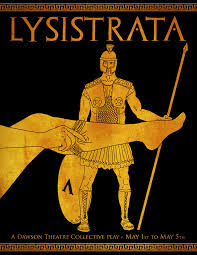
Aristophanes’ famous comedy, Lysistrata, was written in 411 BCE, and staged in Athens during the Peloponnesian Wars, where the conflict between Athenian and Spartan coalitions threatened to destroy the Greek Empire, and as most historians see it, does contribute to the eventual fall of this mighty culture. The play confronts this war directly and outrageously: a union of women from all of Greece, led by the Athenian Lysistrata, decides that the only way to get the men to stop fighting -- is to stage a sex strike.  As Spike Lee’s new film, “Chi-Raq” shades it, “No peace, no piece.”  Spike Lee’s 2015 update on Lysistrata, set among the gang wars and violence in modern Chicago, isn’t the only time in history this play has been used to wage war against war. The anti-war slogan from the Vietnam era, “Make Love, Not War” was taken from Lysistrata. In 2003, actors staged a global reading of this play to protest the United States' invasion of Iraq. And in the late 20th century, women staged sex strikes throughout the world to end localized violence. Also, see my curriculum unit on plagues and the power of women.

It should not be surprising that sexual politics and the politics of government are related, and that a sexual farce could be a strong instrument of peace. Perhaps in a dangerous world, our only hope of defusing the weapons on both sides is laughter. What we all have in common, is love.    

Along the winter road, the AP Literature class will also be studying poetry, including epic poetry. Right now we are examining the powerful poem, “Death Be Not Proud” by the metaphysical 17th-century poet, John Donne. His poetry was featured in a brilliant play by Margaret Edson, called Wit. Please watch this stunning HBO version, directed by Mike Nichols. Donne’s sonnet uses elements of comedy and poetic conceit to take the wind out of death itself -- and give us all the courage to look at winter, and life, from a more powerful perspective.  


Students are also be reading Voltaire's satire, Candide. While we all can agree that this is NOT the "best of all possible worlds", unless we see the flaws, we cannot begin to correct them.


Check out also, Jan Svankmajer's fantastic live and stop-action film of Alice in Wonderland. It is the truest version of this satirical work to be found.


From the college essay of Mike, a blind student at Old Lyme High School, 2013:
I do not let my blindness stop me from doing anything.  My family treats me like I am sighted.  This has made me feel very comfortable with my blindness, and I have a very good sense of humor about it.  I make some of my favorite jokes when sighted people use the word “see”.  I like to make sighted people feel comfortable with my blindness.  I find that sighted people often do not know how to react to my blindness, and making jokes helps them to feel more comfortable.


Monday, February 8, 2021

Greek Tragedy

Important Links
Online Play: Lysistrata  Assignments: Lysistrata Classwork
Online Play: Iphigeneia at Aulis Assignments:  Iphigeneia Classwork
Power Point Presentations: Aristotle's Poetica, Comedy, The Odyssey

Greek Tragedy 
Presently there is a debate in education over the value of studying the humanities. What can you gain from the knowledge of history, literature or art from the distant past? Should schools and universities spend diminishing resources to teach students in the 21st century about events that happened thousands of years ago, or ask students to read the literature or philosophy of people who lived in that "dark backward and abysm of time" (Tempest 1.2) ?  To what purpose?


It is worth noting that the plays written and performed during the “Golden Age of Greek Drama” during the 5th century BCE, were concurrent with the Peloponnesian Wars between Athens and Sparta, which would eventually bring down the entire Greek civilization. These wars shape the background of the plays, which very often deal with war and the suffering of soldiers and civilians. Aristophanes' anti-war play Lysistrata, where women wage a sex strike to stop the death, addresses this conflict. Colombian women's active take on the play resulted in a sex strike to stop gang violence, and in 2003, there was a global performance of Lysistrata to protest the US invasion of Iraq.


Worth reading also is Pericles' Funeral Oration in which Pericles claims Athens is so superior to Sparta that is cannot lose. They do. It is humbling for all who believe that the United States can never fail because of our morally superior government, and for those who would justify U.S. hegemony because of it.


In the linked excerpt from his newly-published book, The Theater of War, Bryan Doerries explains why plays such as Sophocles' Ajax, about a soldier suffering from PTSD, still resonate today. He also connects the plays to the end-of-life experiences of his twenty-two-year-old girlfriend. The message of these timeless works resonates importantly for all of us bound by our own mortality. Their characters model dignity and valor for us in our suffering.  Another doctor describes why the play Philotetes resonates for veterans and anyone suffering from disfiguring wounds.

This is a photograph of Lyndon B. Johnson listening to a tape from his son-in-law, Marine Captain Charles Robb who was serving in Vietnam. In the tape, Robb is describing the deaths of American soldiers as Johnson collapses in anguish. The photo was taken by Jack Kightinger in 1968. This was the deadliest year of the war with 16,592 American soldiers killed. The high losses of American soldiers in the Tet Offensive in February and the moral depravity of the Mi Lai massacre in March of that year put mounting pressure on the American government to end the war. Johnson had already announced that America should take steps to limit the war in Vietnam and that he would not seek re-election. There were massive antiwar protests raging in the streets and on college campuses.

In the years before however, Johnson had been instrumental in escalating the war, believing that he needed to save Vietnam from the spread of communism and from falling under the power of the Soviet Union, a nuclear threat at the time to the United States.  But this was a war that Americans increasingly did not support, and American hegemony was unwelcome in Vietnam. 

The decision to wage war and sacrifice the lives of many is a brutal burden that our modern world has not erased. It is the decision that plagues Agamemnon in Euripides play, Iphigenia at Aulis, when Agamemnon must decide if he would sacrifice his own child in the war he is about to wage in Troy. His inconstancy of moral commitment is something that perhaps should not plague humankind, yet we are creatures who persevere in misguided truths. (See article on cognitive dissonance.) And, check out the following article about a recently discovered grave of a Greek warrior who died as Minoan culture yielded to Mycenaean, that of the heroes who fought at Troy, after which the Greek civilization would face a Dark Age. This is significant in considering Euripides's play Iphigeneia at Aulis, written during the Peloponnesian Wars when Greek culture was facing its final threat.

Indeed, when Robert Kennedy ached to understand how he could announce the assassination of the Rev. Dr. Martin Luther King, Jr. in April of 1968, Jacqueline Onassis advised him to turn to Greek tragedy.  He looked to Aeschylus' Agamemnon to find a character who, after sacrificing his child for political gain, returns home destroyed by grief at his own actions. (Link to speech.) Kennedy's words to a nation broken by racism included these powerful lines derived from this play: “In our sleep, pain which cannot forget falls drop by drop upon the heart until, in our own despair, against our will, comes wisdom through the awful grace of God.” Robert Kennedy would himself be dead in less than two months. In June of this violent year, on his way to winning the Democratic primary for the presidential election, he would become another victim of political assassination.

Presented in Sophocles' Oedipus trilogy are eternal themes: In Oedipus Rex, it is of finding the courage to face trauma and the disease that infects us when we do our best to bury heinous truths. In Oedipus at Colonus it is the excoriating path to finding forgiveness and reconciliation for self and others. In the Antigone, it is the struggle to understand what is right when what you are threatened with death for your beliefs. In the following linked article, an oncologist explains how the play Oedipus at Colonus led her to understanding why it meant more for a terminally-ill patient to leave the hospital for a night than to say there, bound by dying. In another example, a performance of Oedipus Rex at the maximum-security prison Sing Sing proves transforming for inmates whose crimes weigh down their lives. See also: "Denial Makes the World Go Round" and "For Delphic Oracle, Fumes and Visions." Also worth viewing is 1995 film Dead Man Walking, relating to themes of overcoming trauma and unthinkable suffering.

Perhaps more than any other genre of literature, the brilliant tragedies from ancient Greece provide catharsis for the suffering from error caused by our inability to see clearly where our choices will lead. They provide the means of understanding that through human frailty, we inadvertently cause others harm, and must live beyond our own sins and find atonement. Aristotle, in his Poetica makes the claim that art has the moral obligation to edify society and help us all live better lives. As Edith Hamilton, a famous translator of ancient Greek wrote, the literature inspires us "to tame the savageness of man and make gentle the life of the world." These plays indeed provide ways to for us to heal the soul, and are as such perennially worth the effort to bring to students of all ages

Saturday, May 23, 2020

Hamlet

What a piece of work is a man! How noble in reason, how infinite in faculty! In form and moving how express and admirable! In action how like an angel, in apprehension, how like a god! The beauty of the world. The paragon of animals. And yet, to me, what is this quintessence of dust? (Hamlet 2.2)


About a month after the death of Michelangelo in 1564, Shakespeare was born, and the ideals of Renaissance humanism flowed from one creative genius to another. In this monologue from Hamlet, Shakespeare poignantly praises the wondrous power of humanity, matching Michelangelo's humanist portrayal in The Creation of Adam, where Adam and God float in almost the same plane.

Shakespeare's character Hamlet, however while acknowledging the infinite power and beauty of humankind, is suicidal and desperate, and cannot comprehend his own wretched state of existence. This astonishing play leaves 17th century Renaissance and catapults into 20th century anomie and moral relativism:  Hamlet declares sarcastically, "there is nothing either good or bad but thinking makes it so," but in his tormented view, corruption has poisoned everything; he is suicidal and the world seems "weary, stale, flat, and unprofitable." And while the notorious "To be or not to be" speech begins with a contemplation of suicide, it ends with questioning the very purpose of taking action, "Thus conscience does make cowards of us all;/And thus the native hue and resolution /Is sicklied o'er with the pale cast of thought,/And enterprises of great pitch and moment/ With this regard their currents turn awry /And lose the name of action." Hamlet is the epitome of melancholy, and tracing the effects of his malady is one time when attribution of mental health to the Hippocrates' bodily humors makes some sense, at least metaphorically. 

As with most of Shakespeare's plays, the story from Hamlet had appeared in an earlier work, a simple revenge story called The Spanish Tragedy by Thomas Kyd. In this play, a the wife of a man murdered by his brother marries the murderer while her son plots revenge by feigning madness. Shakespeare of course, has the reputation of taking your average popular story and turning  it into a staggering work of genius. From a standard story of a son's revenge, albeit with feigned madness as a ploy, Shakespeare incarnates a densely dysfunctional family whose darkest secrets will never be told. Indeed, Shakespeare eliminates not only the answers, but the questions. Hamlet is in despair, wishing his own flesh would dissolve, obsessed with his mother's sexuality and "incestuous" relationship with his uncle. He is haunted by the ghost of his dead father, whom he reveres and fears, feeling that he himself is a "rogue" and a "slave", a "dull and muddy-mettled rascal". Why can't he avenge his father? Why did his mother remarry so quickly? Why is he so deeply depressed?

As readers, we need to find the darker questions: Why is Hamlet so repulsed by female sexuality? Does Gertrude know that Claudius killed her husband? What are the "black and grained spots" on her soul? What truths does she refuse to uncover? What memories must Hamlet erase about his past life? What secret is it that he must never tell? Indeed, "the rest is silent" at the end of the play, as this story is buried with Hamlet. The psycho-sexual aspects of this play alone seem so shockingly modern. The story of a family torn by possible sexual abuse, suppressed memories, denial, emotional trauma, mental illness and tragic lack of validation for the victim is not only a work of genius in a time before modern psychology, but it is a courageous and astoundingly insightful narrative through which we might see in Hamlet's mirror our own dark traumas, perhaps come to understand the unspoken and denied secrets of ourselves and others, and as Hamlet pleas, uncover the poison within. In the play, these many dark secrets poison all of Denmark.  

For actors, English teachers, intellectuals and literary critics, touching Hamlet is a milestone of accomplishment. All literary critics must tackle this play, all actors strive to play this role, as soul sucking as it might be. Philosophers such as Nietzsche are drawn to him. Everyone wants to claim a bit of Hamlet. He has been described as an existentialist, a Buddhist, a Christian. He has been psychoanalyzed by Freud himself and others as being Oedipal. Lately, he has been diagnosed as schizophrenic or bipolar. The play has been called a dark comedy. And, as Harold Bloom points out, someone who is reactionary, paranoid, angry, brooding, abusive and suicidal -- really is NOT a very nice person.  So why do we forgive him? Why is he so bewilderingly seductive and sympathetic? At the end of the play are our hearts with Horatio's as he watches this extraordinarily troubled young man die and cries,  "Goodnight, sweet prince, / And flights of angels sing thee to thy rest."

Saturday, April 18, 2020

The Zeitgeist of Anglo Saxon Literature

"swa sceal æghwylc mon alætan læn-dagas"
-Beowulf, 2590-2591

Hadrian's Wall
It is not hard to imagine the end of the world.  Consider how many recent films have portrayed a multitude of ways the human race faces the ultimate end of everything. Will we be taken over by cyborgs? Will an asteroid come hurtling towards us? Will thermonuclear war, finally, undo us all? Will harrying aliens take us down? Will it be a plague that dazzles even the most brilliant biological engineer? A singularity that shifts the laws of physics? Will we suddenly realize that in fact, we only exist inside a computer program? Will God, again sick of our corruption, rain the fire of the Apocalypse on us? Will it be, rather, Ragnarok? Thankfully, at least Yael was able to build us a radio. Perhaps we will find a use for it? 

Roslyn Cathedral
At the turn of the first millennium in Anglo Saxon England, there was a kind of millennium madness similar to the one exhibited by people across the globe as we approached the year 2,000. Personally, I must say that I feel sort of special, for not a lot of people will ever have lived to cross a millennium year, and I am one. As we approached the crossover, many people imagined something called "Y2K" -- a bug that was certain to infect the (primitive) computers of the time, which would be unable to handle the change of numbers in the date. (Yeah.) It was much more than that. While the number of the year itself is insignificant, certainly the technological changes swelling through the last decade of the first millennium were. 

The Seafarer, Exeter Book 
Consider that one critical quality of any powerful civilization is the ability to communicate and store knowledge through generations. By the end of the first millennium in the Common Era, human beings were on the brink of being able to store their entire, global ten thousand year library of knowledge and make it accessible to everyone on the planet with Internet connection and a cell phone in seconds. 

Much more than a new millennium, we have surely entered a new age. 

I wonder what the future, confident that there will be one, will call it?

Viking Longship
As the change of the first millennium crossed through England, no one could have imagined the conquest of the Normans, and the coming of a time of dynamic growth for Europe that would rise from the ashes of the fallen Roman Empire. Indeed, England had experience a bit of the Apocalypse when the Romans abandoned the country in 410, as tribal Scots and Picts overran Hadrian's Wall to attack their settlements.

When the Roman patricians buried their treasure and fled, they took the spirit of civilization with them, leaving being the decaying mortality of it: Carved words no one could  understand; buildings, aqueducts, roads and monuments no one had the engineering skills to repair or rebuild; trade routes no one had boats or navigational skills to reach; and technological and medicinal tools and knowledge no one any longer could access. Not to mention having the protection of a safe, powerful, and unified government.

Alfred the Great
England is thrown into chaos as those left behind, the Anglo, Saxons and Jute tribes who were soldiers for the Romans, revert to tribalism, They are unprotected from hunger, disease, the wild forces of nature, or warrior raids from both neighboring tribes and Vikings. Death. Famine. War. Disease. It is a veritable apocalypse of civilization. 

But relentless civilization, truly, one of the most mysterious and awesome qualities of the human species, will rise Phoenix-like from these ashes. Around  the year 900, an Anglo Saxon scop will compose the epic poem Beowulf, even as the language and nation itself is engendering.  A strong king emerges to lead the country. and poets, philosophers, lawyers, historians and everyday people will be writing, translating, and sharing the knowledge of generations past as a dynamic new culture takes hold.  Then, everything will change again in 1066.
Bayeaux Tapestry 

I promise, the Normans won't invade. But what if, hypothetically, leaving cyborgs, zombies, aliens, germs and a paradigm moment in the space time continuum aside, let's say the Internet goes down. Perhaps a very wayward asteroid takes out a number of satellites. Perhaps at the same time, a limited thermonuclear war has ended the global economy as we know it.  Electricity is cut off and there are no longer any deliveries of natural gas, oil, gasoline or coal. Or, perhaps simply, a  pandemic strikes. What will the first week bring? The first month?  Where will humans be in ten years? 

And, when will the next civilization arise? Perhaps on another planet, in another universe, or within electromagnetic impulses that only some futuristic computer can read?  Epic poems are journeys, symbolic of life's journey. And the journey promises to enlighten. 

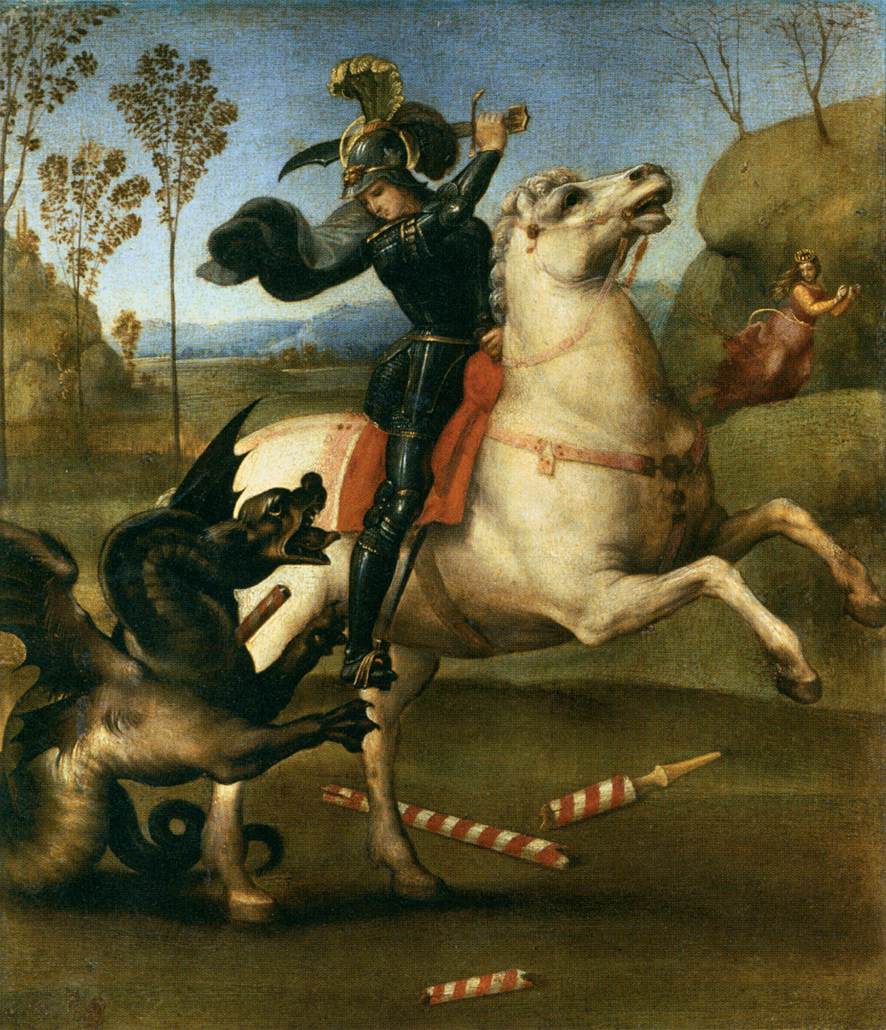
Saint George, Slaying a Dragon


Sunday, March 1, 2020

From Enlightenment (1650-1789) to Romanticism (1789-1914)

Art is the Tree of LIFE.  SCIENCE is the Tree of Death.  

With these words the 18th century poet and fantastical artist William Blake helps to usher in the Romantic Era. Wordsworth would describe Blake as mad, and perhaps the entire 19th century could be considered “mad” as well with its break from rationalism and embrace of subjective reality, the Gothic and the spirit of the imagination.

The Age of Enlightenment rose up from the roots of the Renaissance: Isaac Newton is knighted and Rene Descartes declares, “Je pense, donc je suis.” Baruch Spinoza declares, “The highest activity a human being can attain is learning for understanding, because to understand is to be free.” Politically, Enlightenment ideology is firmly established after the Glorious Revolution in England, which gave Parliament authority over the sovereignty of monarchs. Philosophers such as Thomas Hobbes, Jean-Jacques Rousseau and John Locke expound on human equality, on governments that serve the people, and declare that all people should have the agency of self-determination and freedoms of religion, speech and thought – the very ideals Jefferson declares so eloquently in the Declaration of Independence. But while the American Revolution and the establishment of a government "of the people, by the people and for the people" was perhaps the pinnacle of Enlightenment spirit, the bloodbath caused by the uprising of the peasantry in the French Revolution would mark an end to an idealization of human nature as something moved solely by intellect and order.  
  
And in fact, Lincoln’s Gettysburg Address is a plea that the very democracy “of the people,” created in the optimism of Enlightenment ideology, should not “perish from this earth” as the horror and hypocrisy of slavery seriously challenges the righteous ideals of equality during the Civil War.

Many historians point to July 14, 1789 as the beginning of the Romantic era – of course it is fairly silly to pin an entire transformation of Western ideology on the storming of the Bastille prison in Paris, as the French Revolution begins. Many factors are at play: The Industrial Revolution, which replaces feudal manors with factories; the spreading British Empire, which brings new ideas – and opium – from the Far East; the continued prosperity and rise of the middle class with an increasingly global mercantile exchange; the global displacement of people whose roots once went back centuries in the same land; the questioning of objective reality. The philosopher Immanuel Kant proposes that our own perceptions shape our reality; the famous German writer, poet and philosopher Goethe re-examines the story of Faust, questioning if human passions should be tamed by rationalism. Later in the 19th century, the philosopher Nietzsche will ask the same questions. Indeed, the qualities of human greed and lust, the corruption of power, and the ultimate failure of philosophy and rationalism are predicted in Voltaire’s famous Enlightenment satire, Candide, which is wryly subtitled Optimism.

In America, socials movements that include free love societies, the Transcendentalists, religious revivals, the abolition movement, the brutal institution of slavery – and a brutally bloody Civil War to end it – shape the passion of Romanticism. The expansive and often brutal wilderness of the West is conquered through further bloodshed in the Indian Wars. God is equated with nature, and the powerful, indifferent and unpredictable forces of nature mirror our own.

The elements that define all historical movements can be seen everywhere. They infuse the arts of the era as well. In class, we compared neoclassical music and paintings to those of the Romantic era, and examined the differences between odes: Thomas Gray’s Ode to the Death of a Favourite Cat Drowned in a Tub of Goldfishes and John Keats’ To Autumn. We will be reading Austen’s Pride and Prejudice, which incorporates both Enlightenment and Romantic ideology, and Mary Shelley’s astounding masterpiece, Frankenstein. It should be noted that Mary Shelley's mother, Mary Wollstonecraft, was an Enlightenment feminist, whose work, A Vindication of the Rights of Women, launched the women's movement. Enlightenment thinking of human equality paved the way for many women authors of the 19th century to publish under their own names -- something Jane Austen doesn't do at first -- and have a wide audience.

From the perspective of the Romantic era, personal experience and subjective reality eclipse a notion of objective truth. There is an idealization of peasants and common people, and a hearkening back to the mysticism present in medieval times. Indeed the name “Romantic” is a derivation of medieval romances, the stories of knights on quests to discover spiritual truths. Movements against social injustices caused by slavery, colonialism and industrialization gain traction, and moral relativism takes a stand in works such as Huckleberry Finn, as Huck questions and opposes a law that declares that a black man is property. The nature of evil is questioned as Gothic works such as Frankenstein, Dracula, Wuthering Heights and the works of Edgar Allen Poe create monsters and ghosts that reveal dark psychological desires within. Passion trumps rationalism, people seek to extend their reality through impassioned religious practices, now including Hindu and Buddhism, or through use of opium. And all this during a time also known as the Victorian Era, which often has a veneer of being prim and stuffy. But appearances are often deceptive.